Ask a Question.
Ask a question in plain English and get answers grounded in UK legislation.
ATB uses AI and may make mistakes. Check all information against the original sources before relying on it.
Include the facts, leave out the identifiers
Do include the specifics that change the answer: dates, the kind of tenancy or contract, what notice you received, how long you've been employed, whether things were in writing.
Leave out what adds nothing: names, addresses, employer names, reference or case numbers.
Your question is sent to our AI provider to generate the answer. We don't store it unless you switch history on in your account.

Grounded in UK legislation
Every answer is backed by the original legislation.
Cited and referenced
See the exact source with links to Acts, sections and regulations.
Recent searches
Quickly revisit your previous questions and answers.
Thinking…
Query failed
ATB uses AI and may make mistakes. Check all information against the original sources before relying on it.
Explore an Act
Choose an Act and go straight to the legislation. Explore further with Quick Tools and Deep Analysis when you need them.
Loading Acts…
Read the original text. No credits needed.
Suggested Acts:
Tools for your selected Act
Select an Act ↑
About this Act
Focused tools for your selected Act. Choose a tool, then add a question where supported.
Full structural audits across the whole Act: heavier, more thorough, built for research.
Selected Act
Loading credit cost…
ATB uses AI and may make mistakes. Check all information against the original sources before relying on it.
Running query…
Query failed
Search Case Law
UK Supreme Court judgments: search by topic, Act of Parliament, or the parties involved in a case.
Loading…
UKSC Outcomes
The Supreme Court only hears appeals it grants permission for, so these figures reflect a filtered set of arguable cases, not a random sample of all litigation outcomes.
"Allowed" and "dismissed" describe whether the appellant's own appeal succeeded, not which side originally brought the underlying claim — the state, a company, or an individual can each appear as appellant, so the label alone doesn't indicate who the outcome favoured.
Loading…
Recent judgments
View Constitutional Documents
Founding documents, international treaties, common law principles, Latin maxims, and the statutory oaths that bind office-holders to them.
Loading…
No results found for this search.
Exact matches
Related passages
Looking for Maxims or Legal Terms? They now live under Understanding the Law.
The Constitutional Documents
The founding charters and statutes that set how the United Kingdom is governed. Open one to read it in full, section by section, with plain English alongside.
The Treaties
International agreements the UK has joined, set out article by article with practical guidance on how to cite each one. Open an instrument to read its articles.
The Legal Principles
The common-law doctrines courts reason from. Open a collection to read each principle, where it comes from, and how to use it in argument.

The Statutory Oaths
What MPs, judges, police officers, Privy Counsellors and the Sovereign swear to do on taking office: personal promises that bind office-holders to the constitutional principles set out elsewhere in this library.
Legal Terms
Look up a word or phrase used in UK legislation. Shows its default meaning under the Interpretation Act 1978 where one exists ("unless the contrary intention appears"), and every Act that gives the word its own, different meaning — kept separate, never merged into one averaged definition.
About Ask The Beagle
A legal research tool built to help ordinary people understand the laws that govern them, and the rights those laws give them.
What it is
Ask The Beagle is a legal research tool for anyone who wants to understand UK law, not just lawyers. Most people go their whole lives being governed by rules they've never read: what a public body is actually allowed to do, what a piece of legislation really requires of them, what rights they hold under it. Ask The Beagle searches the actual text of UK legislation, Hansard debates, and constitutional sources, and answers questions from what it finds there, with citations back to the original, so you can read the source for yourself rather than take the tool's word for it.
Why it exists
UK law is public. The Acts of Parliament and the constitutional documents that constrain how the state can treat you: none of it is secret. But "publicly available" isn't the same as "genuinely accessible." It's dense, scattered across dozens of separate sources, cross-referenced in ways that assume you already know where to look, and written in a register aimed at lawyers rather than the people it actually governs. That's true whether you're trying to understand a letter from HMRC, work out what a new Act actually changes for you, or check whether a public body has the power to do what it's just done to you. Ask The Beagle exists to close that gap, not by replacing legal advice, but by making the underlying sources themselves searchable, readable, and traceable, so that understanding your own rights and obligations doesn't require a law degree.
The core commitment
Every answer this tool gives traces to an actual, cited source: an Act, a Hansard debate, a constitutional document. Never invented, never hardcoded, never filled in from general training knowledge dressed up as a citation. If the library doesn't contain something relevant to a question, the honest answer is that it doesn't, not a plausible-sounding guess. This isn't a footnote or a compliance disclaimer; it's the defining design principle the whole tool is built around, and it shapes every retrieval decision described on the How It Works page.
Why a beagle
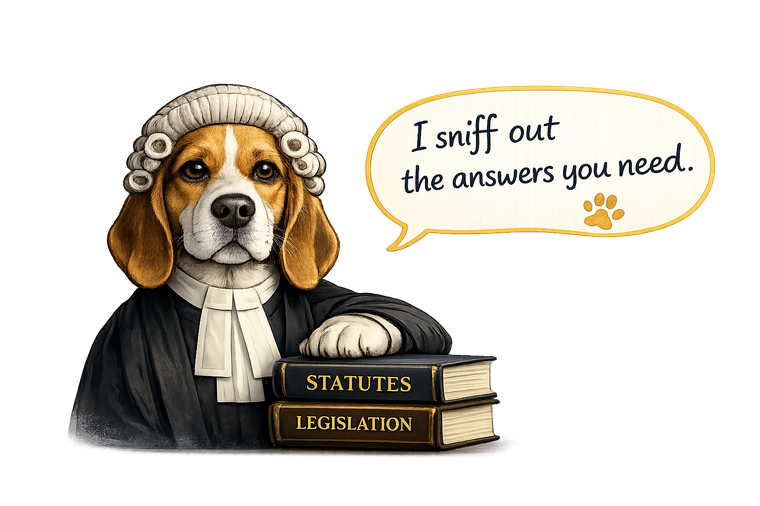
A beagle is a dog bred for one job: pick up a scent and follow it, methodically, all the way back to its source, without losing the trail. That's the actual retrieval approach behind every answer here, not a mascot chosen for its own sake. "I sniff out the answers you need" describes what the tool does, not just how it's branded.
The library, right now
These figures are read from the library when this page loads and describe the legislation and constitutional documents currently available.
Why I built this
There is a legal maxim, Ignorantia juris non excusat, meaning "ignorance of the law is no excuse". People are expected to know the rules which govern them. Yet, with more than 127,000 pieces of legislation and statutory instruments on Legislation.gov.uk, and that body of law continuing to grow every year, I would defy anyone not to be ignorant of most of it.
I wanted to create a tool that makes legislation easier to find, explore and understand, while also allowing forms of analysis that would have been almost impossible just a few short years ago.
The law affects all of us. Understanding it should not be reserved for lawyers, government departments or large organisations.
Ask The Beagle is a tool for the people.
Nigel, founderHow It Works
What the tool actually does when you ask it something about the law, and what it's built from.
Source-first, not general knowledge
When you ask a question, the tool searches the actual text of legislation, Hansard debates, and constitutional documents already ingested into its library, and builds its answer only from what that search finds, with a citation back to the specific source for every claim. It does not answer from general legal knowledge dressed up as if it came from a source. Where a question touches something the library genuinely doesn't cover, the honest answer is that the tool doesn't have a source for it, not an invented one.
What's in the library right now
The library includes UK legislation and explanatory notes, Hansard parliamentary debates, and constitutional sources such as Acts of Parliament, treaties, common law principles, legal maxims and statutory oaths.
What "Plain English" means here
When a section of legislation is shown in Plain English, an AI model rewords that section into ordinary, everyday language, in one or two short paragraphs, using only what the section itself states. That's a genuine rewording, not a summary and not an explanation of legal doctrine: it's built to make dense statutory sentences easier to read, not to preserve or spell out the specific legal meaning of any technical term inside them.
That matters most for terms of art: words that mean something narrower, or different, in law than they do in ordinary speech. "Reasonable" in a statute usually invokes an objective legal standard, not just "seems fair to me"; "malice" in defamation law is a specific test about knowledge of falsity, not everyday spite; "consideration" in contract law is a specific bargained-for exchange, not just a reason for doing something. The Plain English version doesn't reliably flag any of that: it typically swaps the term for an ordinary-sounding synonym (as with "reasonable"), or drops the concept altogether where the surrounding sentence gets rephrased around it (as with "consideration"), rather than explaining what the word is actually doing in law.
So treat Plain English as a reading aid for the shape of a provision, not as a restatement of its legal effect. Where a term of art is doing real work in a provision that matters to you, the original legislative text remains the authoritative source, not the Plain English rewording.
What you can ask it
- Ask a question in plain English: the general-purpose starting point. No need to pick an Act first; ask about your situation and it searches across the whole library for what's relevant.
- Get an Act translated into plain English: turn dense statutory drafting into a plain-language explanation of what a provision actually requires, grounded in the Act's own wording and any official definitions.
- Check for a constitutional conflict: see whether a specific Act's provisions sit uneasily against the Human Rights Act, Magna Carta, the Bill of Rights, or other constitutional sources available in the library.
- Find the exceptions: surface every stated exception, exemption, or defence in an Act, so you're not relying on the general rule alone if a carve-out actually applies to you.
- Explore possible judicial review grounds: examine legislation and constitutional sources for potential grounds of challenge.
- Find gaps in the drafting: undefined powers, provisions that let a Minister change the law without full Parliamentary process, rights with no stated remedy, and similar structural weaknesses in an Act.
- Find where two Acts conflict: surface provisions in different Acts that contradict each other or can't sensibly both apply.
- See who a law actually benefits: identify private interests an Act serves beyond its stated public purpose, grounded in the Act's own explanatory notes and the Parliamentary debate around it; useful wherever the real motive behind a power matters to your situation.
- Map out who owes what to whom: every duty an Act creates, who's meant to enforce it, what the penalty is for breaking it, and where that enforcement is missing entirely.
- See how an Act has been amended over time: which later Acts have modified an earlier one, and whether that was done openly or left to be inferred.
What it isn't
Create an account
Reading the library is free with no account at all. An account adds more searches and analysis, and paid plans raise the limits further. Compare the options:
Sign up
Payment
Already have an account?

Check your email
We have sent a six digit code to — a confirmation code if this is a new address, or a sign-in code if it already has an account. It expires in 15 minutes.
Nothing arrived? Check your spam folder, or .
Account created
Loading plans…